
1,360,745 people: Estonia’s population declined for the second year in a row
According to Statistics Estonia, on 1 January 2026, the population of Estonia stood at 1,360,745. This is 9,250 persons fewer than at the same time the year before. Estonia’s population decreased for the second year in a row. There were 9,240 births and 15,688 deaths last year. 15,212 persons immigrated to Estonia and 18,014 persons emigrated.

Kadri Rootalu, the Population and Education Statistics Service Manager at Statistics Estonia, said that two thirds of the population decline can be attributed to negative natural increase, and one third resulted from net migration which turned negative. “In recent years, net migration had boosted the population figure and helped to offset the negative natural increase. However, in 2025, net migration turned negative after more than ten years, as emigration from Estonia exceeded immigration by 2,802,” said Rootalu. She added that the decrease in population due to negative natural increase was 6,448.
Population change, 2010–2025
| Year | Population change | Net migration | Natural increase |
|---|---|---|---|
| 2010 | -3,630 | -2,484 | 35 |
| 2011 | -4,443 | -2,505 | -565 |
| 2012 | -5,043 | -3,682 | -1,394 |
| 2013 | -4,355 | -2,642 | -1,713 |
| 2014 | -2,548 | -733 | -1,933 |
| 2015 | 2,673 | 2,410 | -1,336 |
| 2016 | -309 | 1,030 | -1,339 |
| 2017 | 3,498 | 5,258 | -1,759 |
| 2018 | 5,687 | 7,071 | -1,384 |
| 2019 | 4,069 | 5,371 | -1,302 |
| 2020 | 1,179 | 3,782 | -2,602 |
| 2021 | 1,728 | 7,043 | -5,315 |
| 2022 | 34,088 | 39,757 | -5,669 |
| 2023 | 8,803 | 13,856 | -5,053 |
| 2024 | -4,692 | 1,374 | -6,066 |
| 2025 | -9,250 | -2,802 | -6,448 |
The average age of mothers at childbirth is rising
9,240 children were born in 2025, which is 450 fewer than in 2024. “The decrease in births last year (−4.6%) was the smallest since 2022, when the sharp decline in the number of births began. The number of births declined by 11.5% in 2024 and by 6% the year before that. Compared to the average of the years 2010–2021, that is, the period before this sharp downtrend, the fall in the number of births has been more than 30%,” explained Rootalu.
The total fertility rate, which takes into account the number of women in fertile age, was 1.16 in 2025. This indicator was 1.18 in 2024 and 1.62, on average, in the period 2017−2021. The average age of women giving birth was 31.2 years. The average age of first-time mothers was 29.4 years. Both of these indicators increased last year, continuing the trends that have prevailed since the re-independence of Estonia.
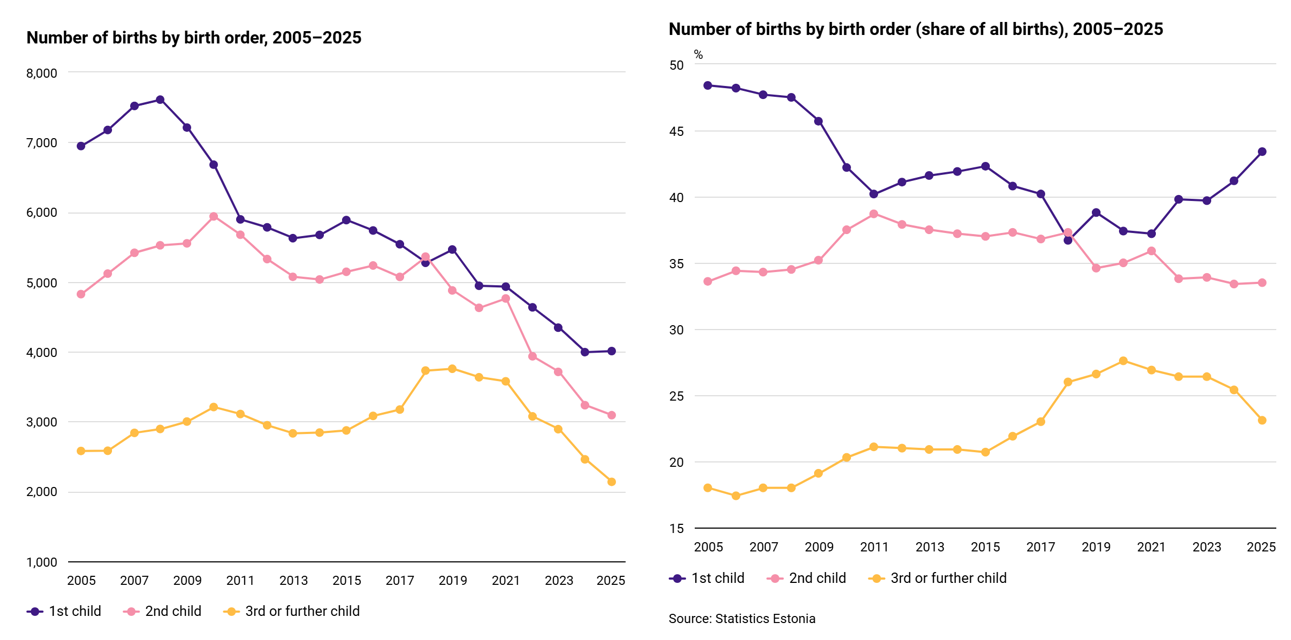
Based on birth order, the largest number of children born in 2025 were first-born children (4,010). Among all live births, 3,092 were second-born children and 2,138 were third-born or subsequent children. Compared with the year before, there was a slightly higher number of first-born children and a lower number of second- and third-born children. “The share of first-born children has increased significantly in the last four years. In 2021, 37% of babies were born to first-time mothers, whereas in 2025 this share was already 43%. Since 2021, there have been 19% fewer first children born, 35% fewer second children born, and 40% fewer third or subsequent children born,” explained Rootalu.
Emigration of Ukrainian citizens continues
According to revised data (covering both registered and unregistered migration), 15,212 people immigrated to Estonia and 18,014 people emigrated in 2025. Both immigration and emigration contributed to the decrease in net migration. “Immigration was down by 3,422 compared with 2024, and emigration was up by 754. Net migration, which had been positive in 2024 (+1,374), ended up being negative in 2025 (−2,802),” said Rootalu to describe the lates migration indicators.
The Russia-Ukraine war still influences migration. “In previous years, Ukrainian citizens have held a significant share among immigrants, while in the last two years they have held a noticeably larger share among emigrants as well,” said Rootalu. “The increase in emigration can mainly be attributed to Ukrainian citizens but also to Estonian citizens who are leaving. To a degree, emigration indicators are influenced by the methodology of migration statistics: if a person leaving Estonia does not register their emigration, Statistics Estonia will receive this information with some delay,” said Rootalu as an explanation for the considerably larger number of Ukrainians among emigrants in the last year. She suggested that some of them may actually have left earlier.
Last year, 4,672 Estonian citizens arrived in the country and 6,238 left, i.e. departures exceeded arrivals by 1,611. In the case of Ukrainian citizens, there were also more emigrants (5,617) than immigrants last year (4,791).
Who are Estonia’s residents?
18.7% of Estonia’s residents are minors, i.e. aged under 18. The share of 18–64-year-olds is 59.9%. Residents aged 65 and over constitute 21.4% of the population. Year on year, the share of minors decreased and the share of residents in pensionable age increased.
Men constitute 47.5% of the population, and the share of women is 52.5%.
82.2% (1,119,000) of Estonia’s residents have Estonian citizenship. 5.5% have Russian citizenship, 4.6% have Ukrainian citizenship and 4.3% have undetermined citizenship. The remaining 3.4% of residents are citizens of other countries. Ethnic Estonians account for 68.5% (933,000) of the total population, which is similar to the year before.
The revised population figure published by Statistics Estonia takes into account unregistered migration in addition to the preliminary population number published in January.
The differences in methodologies are described in Statistics Estonia’s blog post (in Estonian).
More detailed data have been published in the statistical database.
See also the population section on our website.
Information on the data sources and methodologies used in population statistics is available in the methodology report.
When using Statistics Estonia’s data and graphs, please indicate the source.
For further information:
Annaliisa Köss
Media Relations Manager
Marketing and Dissemination Department
Statistics Estonia
Tel +372 5696 6484